

The final aesthetic outcome of an abdominoplasty is defined as much by the meticulous clinical management of your recovery as it is by the surgical technique itself. It’s natural to feel a sense of apprehension regarding the physical sensations and the timeline of healing following such a significant transformation. You likely recognize that achieving your surgical goals requires a disciplined approach to post-operative care and a thorough understanding of the physiological changes your body will undergo. This professional guide outlines exactly what to expect after tummy tuck surgery, also known as abdominoplasty, by providing a detailed clinical roadmap for your healing journey.
We’ve structured this overview to address your concerns about pain management, wound integrity, and the gradual resumption of physical activity. You’ll gain a clear understanding of the 42-day recovery arc, from the initial inflammatory phase to the maturation of surgical scars. By identifying specific clinical red flags and establishing realistic expectations for your physical restrictions, you can navigate your post-operative period with the clarity that comes from being well-informed. We’ll examine the first 24 hours of care, the critical 14-day window for wound healing, and the necessary steps to support a stable result.
Key Takeaways
- Understand the clinical requirements of the immediate 24 to 48-hour post-operative period, including the management of surgical drains to minimize the risk of seroma formation.
- Gain a realistic overview of what to expect after tummy tuck surgery (abdominoplasty) during the first fortnight, focusing on wound care protocols and the necessity of a dedicated support person.
- Identify the critical milestones from weeks three to six, where the focus shifts toward tissue maturation and the consistent use of medical-grade compression garments for support.
- Learn about the long-term biological stages of scar maturation over 12 to 18 months and the importance of clinical skin protection to prevent incision hyperpigmentation.
- Navigate the Australian regulatory landscape by understanding the mandatory cooling-off periods and the significance of selecting an AHPRA-registered Specialist Plastic Surgeon.
Immediate Post-Operative Care Following Abdominoplasty (Tummy Tuck Surgery)
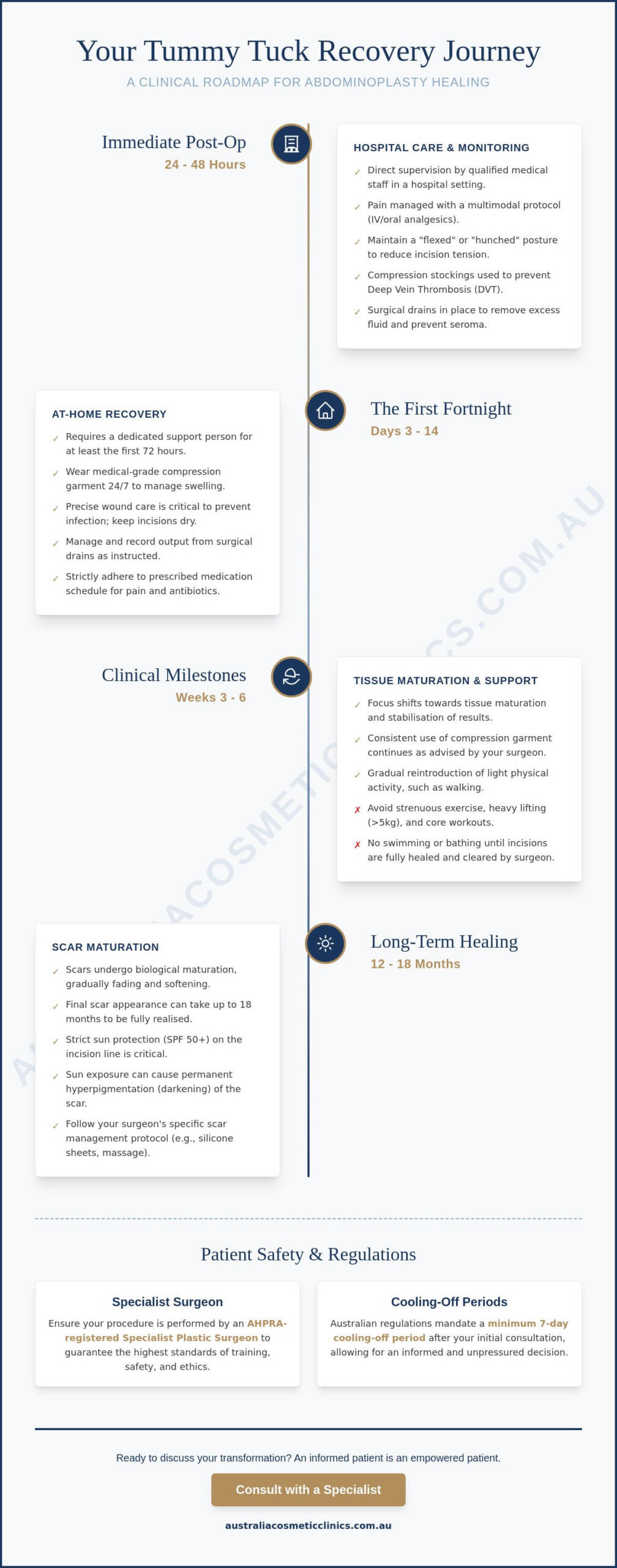
The first 24 to 48 hours following Abdominoplasty (tummy tuck) are a critical phase of your clinical recovery. During this period, you’ll remain in a monitored hospital setting under the direct supervision of qualified medical staff. This environment is essential for monitoring your vital signs and managing the immediate physiological responses to the procedure. You’ll likely feel quite tired and your abdomen will feel tight. Clinical staff will encourage you to adopt a “flexed” or “hunched” posture when standing or walking. This specific position reduces tension on the primary incision line, which is vital for wound integrity and reducing the risk of dehiscence. Understanding what to expect after tummy tuck surgery helps you prepare for these physical limitations during your hospital stay.
Pain management is a clinical priority. Your surgical team will implement a multimodal protocol to keep you comfortable. This often involves a combination of long-acting local anaesthetics administered during surgery and intravenous or oral analgesics provided post-operatively. Every patient’s pain threshold is different, and the clinical team will adjust your medication based on your feedback and objective observations. These protocols follow strict Australian safety standards to ensure patient comfort while prioritising safety.
Waking Up from Anaesthesia
As the general anaesthetic wears off, you’ll experience a period of grogginess. Nausea is a common side effect, but your clinical team can manage this effectively with anti-emetic medications. You’ll notice compression stockings on your legs, often paired with sequential compression devices (SCDs). These devices use intermittent pressure to maintain blood flow and are a standard requirement in Australian hospitals to prevent Deep Vein Thrombosis (DVT). If your surgeon deems it appropriate, you may use a Patient-Controlled Analgesia (PCA) pump. This allows you to self-administer precise doses of pain relief within safe, pre-programmed clinical limits, giving you autonomy over your comfort levels.
The Role of Surgical Drains
Most patients have small, flexible surgical drains placed beneath the skin during the procedure. These are vital for removing excess blood and lymphatic fluid that naturally accumulates after the surgery. By removing this fluid, the drains help prevent the formation of a seroma, which is a pocket of fluid that can interfere with the healing process. Your nurses will monitor and record the volume of fluid collected every few hours. You’ll typically need to keep these drains in place for 7 to 14 days, depending on your individual rate of recovery and fluid output. Knowing what to expect after tummy tuck surgery regarding drain care is essential, as you’ll likely be discharged with them still in situ and will need to record output levels at home.
Any surgical procedure carries risks. Your surgery will be performed by [Practitioner Name], [MED Number], a Specialist Plastic Surgeon. Results vary between individuals.
The Recovery Timeline: Your First Fourteen Days at Home
Transitioning from the clinical environment to home care is a pivotal stage in your surgical journey. You’ll require a dedicated support person for at least the first 72 hours to assist with basic movements, meal preparation, and medication management. Understanding what to expect after tummy tuck surgery, clinically known as an abdominoplasty, requires a focus on physiological stabilisation. During this period, managing oedema and bruising is your primary objective. You’ll wear a medical-grade compression garment 24 hours a day to support the abdominal wall and minimize fluid accumulation.
Wound care must be performed with precision to prevent infection. You’ll receive specific instructions on how to keep the incision sites dry and when it’s appropriate to shower. Following My Health Alberta’s at-home recovery guide can provide additional clarity on monitoring your incisions for signs of complications. Adhering to your prescribed medication schedule is vital for comfort. You must avoid anti-inflammatory drugs like aspirin or ibuprofen for at least 14 days, as these can interfere with blood clotting and increase the risk of a haematoma.
Day 1 to Day 7: The Acute Healing Phase
The first week focuses on protecting the surgical repair while maintaining healthy circulation. You’ll need to rest in a semi-Fowler’s position, which involves keeping your back and knees elevated at a 30 to 45 degree angle. This posture reduces tension on the abdominal sutures. Despite the need for rest, you must perform short, frequent walks around your home every few hours. These brief movements are essential for preventing deep vein thrombosis. Constipation often occurs due to the combination of anaesthesia and opioid pain relief. Integrating high-fibre foods and maintaining significant hydration levels will help manage this common post-surgical issue.
Day 8 to Day 14: Gradual Mobilisation
By the second week, the initial intensity of the recovery begins to subside. You’ll likely notice a gradual reduction in acute swelling, though some discomfort remains. As the tension in the skin and underlying tissues allows, you can begin to slowly straighten your posture. Your first post-operative follow-up appointment typically occurs during this timeframe. Your surgeon will evaluate the healing of the incision and may remove any remaining surgical drains or non-dissolvable sutures. Many patients find they can transition from prescription analgesics to over-the-counter paracetamol during these days. If you have questions about your individual progress, you can seek guidance during your post-operative clinical review.
Clinical Milestones: Weeks Three to Six Post-Surgery
By the third week, your body transitions from the acute inflammatory phase into the proliferative stage of tissue maturation. This period is crucial for the stabilization of the internal sutures used during your abdominoplasty. You’ll notice a gradual reduction in bruising, although residual swelling, or oedema, often persists. Maintaining the use of your medical-grade compression garment remains a clinical necessity during this window. These garments provide the external pressure required to minimize fluid accumulation and support the abdominal contours as the skin adheres to the underlying fascia. It’s a phase where patience is as vital as physical rest.
Returning to Work and Social Activity
Most patients find they can return to sedentary professional duties between 14 and 21 days post-surgery. If your role involves significant standing or light physical tasks, you may require four full weeks of leave. Post-operative fatigue is a common clinical observation during this stage; your body diverts significant metabolic energy toward cellular repair. Understanding what to expect after tummy tuck surgery involves recognizing these energy fluctuations. You must strictly avoid lifting any objects over 5kg. This restriction prevents unnecessary intra-abdominal pressure that could compromise your internal repair or lead to complications. During this period of rest, you might also consider future career goals; for example, you can explore CHC50125 Diploma of Early Childhood Education and Care through Axiom College to see how vocational training could fit into your post-recovery plans.
Physical Activity Restrictions
While you might feel more mobile, your internal tissues haven’t regained their full tensile strength. Clinical protocols indicate that abdominal core exercises must be avoided for a minimum of 6 to 12 weeks. Engaging the rectus abdominis too early increases the risk of incisional dehiscence, where the surgical wound separates. This complication can lead to wider scarring or the need for secondary revision. Approved movement includes:
- Gentle walking on flat surfaces to promote healthy circulation.
- Light household tasks that don’t require reaching or bending.
- Short, frequent periods of standing to prevent stiffness.
Low-impact walking reduces the risk of deep vein thrombosis without straining the surgical site. You’re moving toward your final result, but the internal healing process cannot be rushed. You should also wait until you’re no longer taking prescription pain medication and have regained full range of motion before resuming light driving, which typically occurs around week three or four.
Managing Long-Term Healing and Surgical Scarring
Abdominoplasty recovery is a physiological process that requires patience and adherence to clinical protocols. Your incision undergoes three distinct biological phases: inflammation, proliferation, and maturation. This final maturation stage typically spans 12 to 18 months. During this period, the scar initially appears pink and may feel slightly raised before it gradually flattens and fades to a pale, silver-white tone. Protecting the site from ultraviolet (UV) radiation is mandatory. Exposure to the sun during the first 12 months can lead to permanent hyperpigmentation, causing the scar to darken significantly. You should use high-SPF sunscreen or physical barriers whenever the area is exposed to the Australian sun.
You will likely experience localized numbness or “pins and needles” around the incision and lower abdominal wall. This occurs because tiny sensory nerves are disrupted during the procedure. Nerve regeneration is a slow process, typically progressing at a rate of approximately one millimetre per day. Most patients notice a return of sensation within 6 to 12 months, though some small areas of diminished feeling may persist permanently. Understanding what to expect after tummy tuck surgery involves recognizing these sensory shifts as a standard part of the neurological healing response.
Evidence-Based Scar Management
Clinical evidence supports the use of medical-grade silicone gel sheeting or topical silicone gels to maintain hydration and regulate collagen production at the incision site. Once your specialist plastic surgeon confirms the wound has fully closed, usually around the four-week mark, you can begin gentle scar massage. This technique helps break down internal adhesions and improves tissue pliability. For patients seeking further refinement, vascular or fractionated laser therapies may be discussed after six months to address residual redness or texture. These treatments are tailored to your specific skin type and healing progress.
Normal Variations vs. Clinical Concerns
It’s important to distinguish between standard healing and clinical complications. You might encounter “spitting sutures,” which occur when the body’s natural inflammatory response pushes a dissolvable internal stitch to the surface. These often appear as small, red bumps and are managed by your clinical team during routine follow-up appointments. It’s also normal for the abdominal wall to feel firm or “tight” for several months. This induration eventually softens as internal oedema (swelling) resolves. Final aesthetic results are typically assessed at the 12-month mark, once the tissues have reached their stable, post-surgical state. Knowing what to expect after tummy tuck surgery helps you remain calm as your body transitions through these necessary stages of repair.
To discuss your long-term recovery plan with an experienced clinical team, you can contact the specialists at Australia Cosmetic Clinics.
Patient Safety and Specialist Plastic Surgeon Credentials
Choosing to undergo abdominoplasty is a significant decision that requires a commitment to both the surgical process and the subsequent healing phase. Your safety depends heavily on the clinical environment and the expertise of your surgical team. Within the Australian regulatory framework, patient protection is prioritized through strict standards managed by the Australian Health Practitioner Regulation Agency (AHPRA). Understanding what to expect after tummy tuck surgery begins with ensuring your practitioner possesses the appropriate specialist recognition to manage your care and any potential complications.
Just as you look for accredited medical specialists to ensure surgical safety, other critical sectors in Australia rely on niche expertise to protect the public. In the field of transport planning and urban infrastructure, ML Traffic Engineers Australia provides the specialized engineering consultancy required to manage complex traffic systems safely and efficiently.
Verifying Surgeon Qualifications
Patients should always verify a practitioner’s credentials on the AHPRA register before booking a consultation. It’s vital to distinguish between a ‘Specialist Plastic Surgeon’ and a ‘Cosmetic Surgeon.’ A Specialist Plastic Surgeon has completed a minimum of 12 years of medical and surgical education, including at least five years of specialist postgraduate training. Dr Mark Kohout (MED0001193910) is a Specialist Plastic Surgeon with over 25 years of surgical experience, providing a foundation of clinical authority for every procedure. While some doctors may use the title ‘Cosmetic Surgeon,’ this does not always indicate the same level of accredited specialist surgical training required for AHPRA specialist registration in plastic surgery.
The Australian government introduced updated regulations on 1 July 2023 to enhance patient safety. These include a mandatory seven-day cooling-off period after you sign a consent form and before your procedure takes place. You’re also required to have at least two pre-operative consultations. These steps ensure you have ample time to process clinical information without external pressure, allowing for an informed and measured decision regarding your surgical journey.
Understanding the Risks of Surgery
Every major surgical procedure carries inherent risks that patients must weigh carefully. A transparent clinical approach involves a thorough discussion of potential complications during your initial consultations. While many patients experience an uneventful recovery, you must be aware of the following possibilities:
- Infection at the incision site requiring antibiotic intervention.
- Haematoma or seroma (fluid accumulation) that may necessitate drainage.
- Delayed wound healing or skin necrosis, particularly in the lower abdominal area.
- Asymmetry or unsatisfactory scarring that might require secondary revision.
- Deep vein thrombosis (DVT) or pulmonary embolism.
- Changes in skin sensation or persistent numbness.
To begin this process in Australia, you must obtain a referral from your General Practitioner (GP) before your first consultation with a specialist. This requirement ensures that your primary healthcare provider is involved in your medical history assessment. When considering what to expect after tummy tuck surgery, remember that a successful outcome is a collaborative effort between your surgeon’s technical precision and your adherence to post-operative protocols. If you’re ready to take the next step, Book a consultation with Specialist Plastic Surgeon Dr Mark Kohout to discuss your abdominoplasty options.
Navigating Your Abdominoplasty Recovery Journey
Recovery from an abdominoplasty is a structured process that requires strict adherence to clinical protocols for optimal wound healing. The initial 14-day period is critical for rest and restricted movement, while the following month involves the gradual reintegration of daily activities as your physical milestones are met. Understanding what to expect after tummy tuck surgery helps you manage the practicalities of post-operative life and ensures you have the necessary support systems in place. It’s essential to maintain realistic expectations regarding the timeline for scar maturation and the resolution of swelling.
Dr Mark Kohout (MED0001193910) is a Specialist Plastic Surgeon who provides thorough clinical oversight throughout your healing process. With over 25 years of surgical experience in Sydney and Orange, he operates under strict AHPRA safety and ethical guidelines. Choosing a qualified specialist ensures that your care is grounded in medical precision and transparent communication regarding potential risks and recovery requirements. We’re here to provide the clinical guidance you need as you move through each stage of your recovery.
Schedule a clinical consultation with Dr Mark Kohout, Specialist Plastic Surgeon to discuss your specific surgical needs and receive a comprehensive assessment. We’re committed to supporting your clinical journey with professional expertise and care.
Frequently Asked Questions
How much pain should I expect after abdominoplasty surgery?
You should expect moderate to significant discomfort during the first 72 to 120 hours following your procedure. We manage this through a bespoke clinical pain management plan, which typically includes prescribed analgesics and local anaesthetic blocks administered during the surgery. While the most intense sensations subside within the first week, a dull ache or tightness often persists for several weeks as your tissues adapt.
When can I stop wearing my compression garment after the procedure?
You’ll typically need to wear your medical-grade compression garment 24 hours a day for the first 6 weeks post-surgery. This garment is essential for managing post-operative oedema and providing necessary structural support to the abdominal wall during the initial healing phase. After this 6-week period, your surgeon may advise transitioning to daytime wear only for an additional 14 to 21 days based on your progress.
How long do I need to take off work for an abdominoplasty recovery?
Most patients require 2 to 3 weeks of recovery time before returning to sedentary office roles. Understanding what to expect after tummy tuck surgery involves planning for this period of rest to prevent complications like wound dehiscence. If your occupation involves physical activity or standing for extended periods, you should plan for 4 to 6 weeks of leave to ensure your incision sites aren’t compromised.
When is it safe to resume exercise and heavy lifting after surgery?
You can begin light walking within 24 hours to promote circulation, but you must avoid heavy lifting and strenuous exercise for at least 6 to 8 weeks. Resuming high-impact activities too early can strain the internal sutures used for muscle repair and increase the risk of seroma formation. Your surgeon will provide a graduated exercise clearance based on clinical assessments during your follow-up appointments at the 2 and 6-week marks.
What are the clinical signs of an infection or blood clot I should watch for?
Clinical signs of infection include a fever over 38°C, increasing redness, warmth around the incision, or malodorous discharge. To monitor for Deep Vein Thrombosis, watch for unilateral leg swelling, calf tenderness, or sudden shortness of breath. If you observe any of these symptoms, you must contact our clinical team or seek emergency medical attention immediately to ensure your health and clinical stability.
Will I be able to stand up straight immediately after the surgery?
You won’t be able to stand fully upright immediately after the procedure due to the tension placed on the abdominal skin and underlying muscle repair. Most patients maintain a slightly stooped posture for the first 7 to 14 days to protect the incision line from excessive stress. By the end of the second week, you’ll gradually find it more comfortable to straighten your torso as the tissues regain their elasticity.
How long will it take for the surgical swelling to completely disappear?
While the most visible swelling subsides within 6 to 8 weeks, it takes 6 to 12 months for residual oedema to completely resolve. Factors like your activity levels, sodium intake, and adherence to compression therapy influence this timeline. You’ll notice your final aesthetic results and the full effect of your abdominal rejuvenation emerging more clearly once the lymphatic system fully adapts to the surgical changes.
Is a GP referral required before I can book a surgical consultation?
Yes, a valid referral from your General Practitioner is a mandatory requirement before you can book a consultation for cosmetic surgery in Australia. This regulation, introduced by AHPRA on 1 July 2023, ensures that your physical and psychological suitability for surgery is assessed by an independent doctor first. Your GP referral provides our specialist surgeons with a comprehensive medical history, facilitating a clinically appropriate and informed surgical journey.
